
Welcome to the Long COVID Service
What is Long COVID?
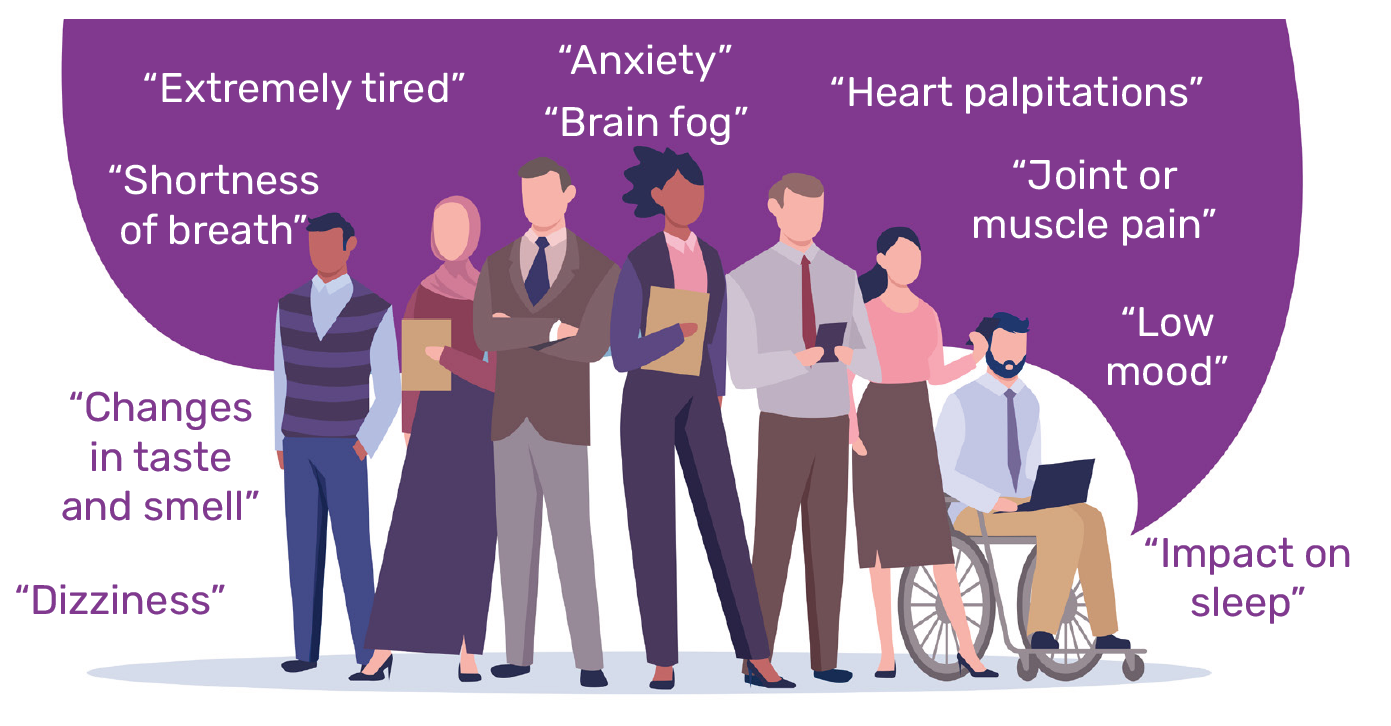
“Long Covid is a multi-system condition with a range of debilitating symptoms – signs and symptoms continue or develop after acute Covid-19, continue for more than 4 weeks, and are not explained by an alternative diagnosis.” (NICE, 2022).
Read the National Institute for Health and Care Excellence COVID-19 rapid guideline: managing the long-term effects of COVID-19.
Please note, each patient with Long COVID has a unique set of symptoms, needs and circumstances. A care plan will be tailored and agreed with your clinician.
What does our service offer?
The Sirona Community Long COVID Service supports adults who still have symptoms related to a COVID infection 12 weeks (or four weeks if severe) after their acute infection. The aim of the service is to assess ongoing symptoms and their impact on daily function and wellbeing. We can then provide support to access resources and/or services to enable adjustments to support symptom management and recovery.
We are a multidisciplinary team of professionals who all have experience in rehabilitation and long – term condition management
The management of patients with Long COVID will usually focus on lifestyle factors, pacing and psychological support.
Meaningful Movement Programme
The Long COVID Service is piloting a programme to help people living with Long COVID to increase skills and confidence around movement.
People with Long COVID often tell us that they struggle with how to integrate movement into their daily life. Movement is essential for health however, we understand that Long COVID can make moving more difficult.
The tailored programme aims to support patients to build skills and confidence around moving, whilst focussing on what type of movement is important to them. We can support with building the foundations of safe and meaningful movement which can be embedded into daily life after the programme, as part of self-management.
Posters:
Service testimonials
How can I access the service?
We currently only accept referrals from GP’s. This is to ensure all patients are appropriately assessed before referral to exclude any other causes for their symptoms.
A GP/Healthcare Practitioner will be able to make a referral directly. Guidance is available on:
See our video for more information about getting help from our Long Covid Service.
Video edited on Kapwing
I've been referred, what happens next?
On reaching the top of our waiting list, you will be offered an initial assessment, usually by telephone and lasting approximately 45 minutes.
Following your initial assessment, you and your clinician will discuss the most suitable support options and together will agree a rehabilitation plan.
The Long COVID Service is designed to offer an initial assessment and one or two follow-up appointments to establish a definitive treatment plan. Discuss with your clinician whether telephone, video or face to face appointments are most suitable for you.
A variety of pathways may be available for you, both inhouse or led by other services we work closely with.
Important:
We are not an urgent or emergency care service. If you develop new or progressively worsening symptoms, you must seek medical advice either via your GP, 111 or if life threatening then 999.
Your GP will remain responsible for your medical care.
Click the image below to see the journey of someone using our service:

Please note, each patient with Long COVID has a unique set of symptoms, needs and circumstances. A care plan will be tailored and agreed with your clinician.
What can I do whilst I wait for my initial assessment?
Being unwell with COVID-19 and being unwell for a longer time can be distressing, and people can feel worried, anxious and struggle with their mood and sleep. It can be frustrating when symptoms feel out of our control. It’s important to understand how to manage energy levels and pace yourself to spread out activity by alternating it with rest periods rather than falling into a boom and bust cycle, as seen below.

The Boom Bust Cycle
Day 1: Having a ‘good’ day, completing a lot of activities (Boom).
Day 2/3: Due to overdoing yourself on the ‘good’ day you suffer with increased fatigue the following day and need rest (Bust).
Day 4: After the rest days, you feel better so go back to doing a lot of activities (Boom).
Day 5: Again you suffer with another increased period of fatigue and need to rest for another day (Bust).
Day 6: Due to the rest day you have another ‘good’ day (Boom).
Day 7: This leads to another increase in fatigue symptoms (Bust).
Top tips
Click the image below to download a poster showing five top tips from the Long COVID service.

Below are some resources to try which may help manage symptoms:
Top Tips for friends, family, carers and colleagues
Long COVID will affect not only the person living with the condition, but also the people close to them. The person living with Long COVID may need more support than usual, which will help them as they recover or manage their condition. Long COVID is a fluctuating condition by nature and every caring situation is unique so this might involve providing support with everyday jobs around the home, emotional support, help with administrative tasks or giving personal care. It is important for carers to not to neglect their own physical and mental wellbeing, including maintaining social connections. Looking after their own needs alongside those of the person with Long COVID will ultimately ensure they are in a good position to provide care.
Research
At the time of writing, there is no known definitive cause for why some people develop Long COVID Syndrome and others do not. It is likely that there will be multiple causes and mechanisms.
Research is underway globally to help us understand the mechanisms, cause for symptoms and possible treatments, but due to the nature of clinical research there can be a delay with implementation into practice due to strict safety considerations.
We understand your frustration and are working hard to implement findings that are proven to be clinically effective.
Useful links
The resources below might be relevant and helpful for you.
- Long Covid SOS Charity | Recognition Research Rehabilitation.
- Physiotherapy for breathing pattern disorders resources for physiotherapists (physiotherapyforbpd.org.uk)
- How to manage your energy levels – RCOT
- Smell Taste: Charity for all those living with impaired smell and taste.
- Postural Orthostatic Tachycardia Syndrome
- NHS Talking Therapies – North Somerset & South Gloucestershire
- Tinnitus UK
- Carers Support Centre
- Financial advice from Citizens Advice
- North Bristol Advice Centre Welfare and financial advice.


